
Configuration
1 Recipient resolution
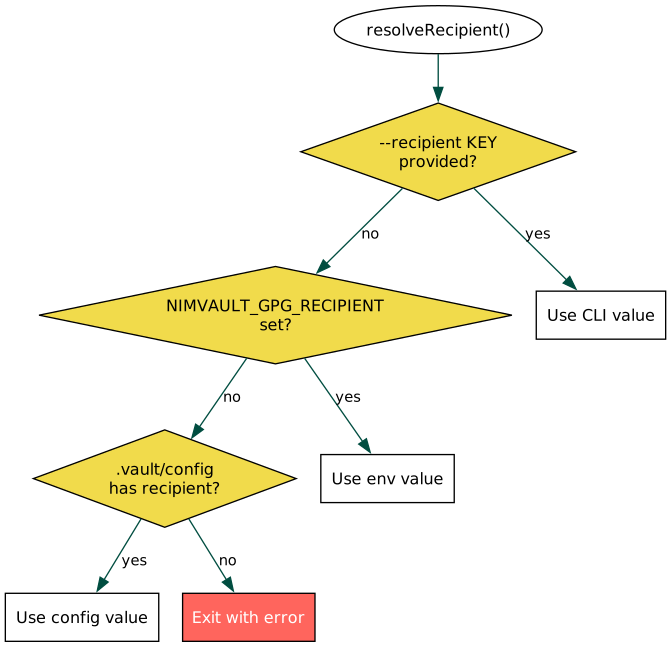
nimvault resolves the GPG recipient through a 3-tier chain. The first non-empty value wins:
CLI flag:
--recipient KEY(or-r KEY)Environment variable:
NIMVAULT_GPG_RECIPIENTConfig file:
.vault/configin the git repository root
If none are set, nimvault exits with an error.
2 Config file format
.vault/config uses a simple key-value format:
# Lines starting with # are comments
recipient = 9CCCE36402CB49A6
root = repo
Whitespace around the = is ignored. Recognized keys:
recipientGPG key ID for encryption (required).
rootBase directory for path resolution. When set to
repo, paths are stored relative to the repository root. When set to a relative path, it is resolved against the repository root. When absent, paths use~/prefix for portability.wrapRepeatable.
<glob>:<recipient>[,<recipient>...]– which recipients may open the entries matching a path pattern. See below.backendgpg(default) orage. AlsoNIMVAULT_BACKEND.identityAge identity file. Also
NIMVAULT_AGE_IDENTITY.signergpg(default for the GPG backend),ssh(default for age), ornone.sign_keySSH private key used to sign the manifest when
signer = ssh.allowed_signersSSH allowed-signers file used to verify that signature.
signer_identityPrincipal to match inside
allowed_signers.
3 Per-path recipients
Not every machine should read every secret. A wrap rule maps a path pattern
to the recipients allowed to open those entries:
recipient = LAPTOPKEY

# Specific rules first: the first match decides.
wrap = ~/.ssh/**:LAPTOPKEY
wrap = ~/.gnupg/**:LAPTOPKEY
wrap = **:LAPTOPKEY,BUILDBOXKEY
Order in the file is precedence, so the narrow rules go above the general one.
An entry matching no rule uses recipient, which is why a config with no
wrap lines behaves exactly as it did before rules existed.
3.1 How it works
Each entry’s payload is encrypted under its own data key (see the manifest
reference). The data keys are grouped by recipient set, and each group is
written to its own .vault/keys.<group>.gpg encrypted to that group alone. A
machine decrypts the group files its key opens and no others, so it can read
exactly the entries meant for it.
unseal on such a machine restores what it can read. check needs no key at
all, so vault integrity is verifiable from anywhere.
Patterns: \* matches within one path segment, \*\* spans separators, and a
pattern ending in / covers everything beneath it. Patterns are anchored at
both ends, so ~/x/* does not match ~/x/deep/one.
3.2 Changing the rules
Editing wrap rules does not move anything by itself. Run nimvault rotate:
it recomputes each entry’s group and rewrites the key files, leaving payloads
untouched. An entry that moved group has its key written to the new group’s
file and dropped from the old one.
3.3 A prerequisite worth stating
Groups are only worth anything when the machines hold different keys. If every machine shares one private key, every machine can open every group and the split is decoration. Give each machine its own key and exchange public keys before relying on this.
3.4 Break-glass recovery
Because a group takes several recipients, an offline key – generated once, printed or kept on removable media, never on any machine – can be added to the general rule. It then opens the vault if every machine is lost, without a threshold scheme or any additional machinery.
4 GPG key ID
The recipient value is any string GPG accepts as a recipient identifier:
Long key ID:
9CCCE36402CB49A6Fingerprint:
ABCD1234...Email:
user@example.com
Long key IDs are recommended for unambiguous matching.
4.1 Finding your key ID
gpg --list-keys --keyid-format long
# pub   rsa4096/9CCCE36402CB49A6 2024-01-01 [SC]
#                ^^^^^^^^^^^^^^^^ this is the key ID